The Same Mistake That Caused the Peanut Allergy Epidemic Is Happening in Cardiac Arrest Management

A paramedic pushes cardiac arrest dose epinephrine into a 6-month-old with a heart rate in the fifties and a pulse he could still feel. Full arrest dose. The same 0.01 mg/kg he would have given if her heart had already stopped. She did not code. But that’s the dose the guidelines recommend, even though there’s evidence to the contrary.
I’ve written about this in the past, but the memory came rushing back this week while I was reading the opening chapter of Dr. Marty Makary’s latest book, Blind Spots: When Medicine Gets It Wrong, and What It Means for Our Health.1 Huge thanks to Steve Wirth for the book recommendation. Makary previewed this chapter a year earlier in the Wall Street Journal, in an essay called How Pediatricians Created the Peanut Allergy Epidemic, published September 19, 2024.12
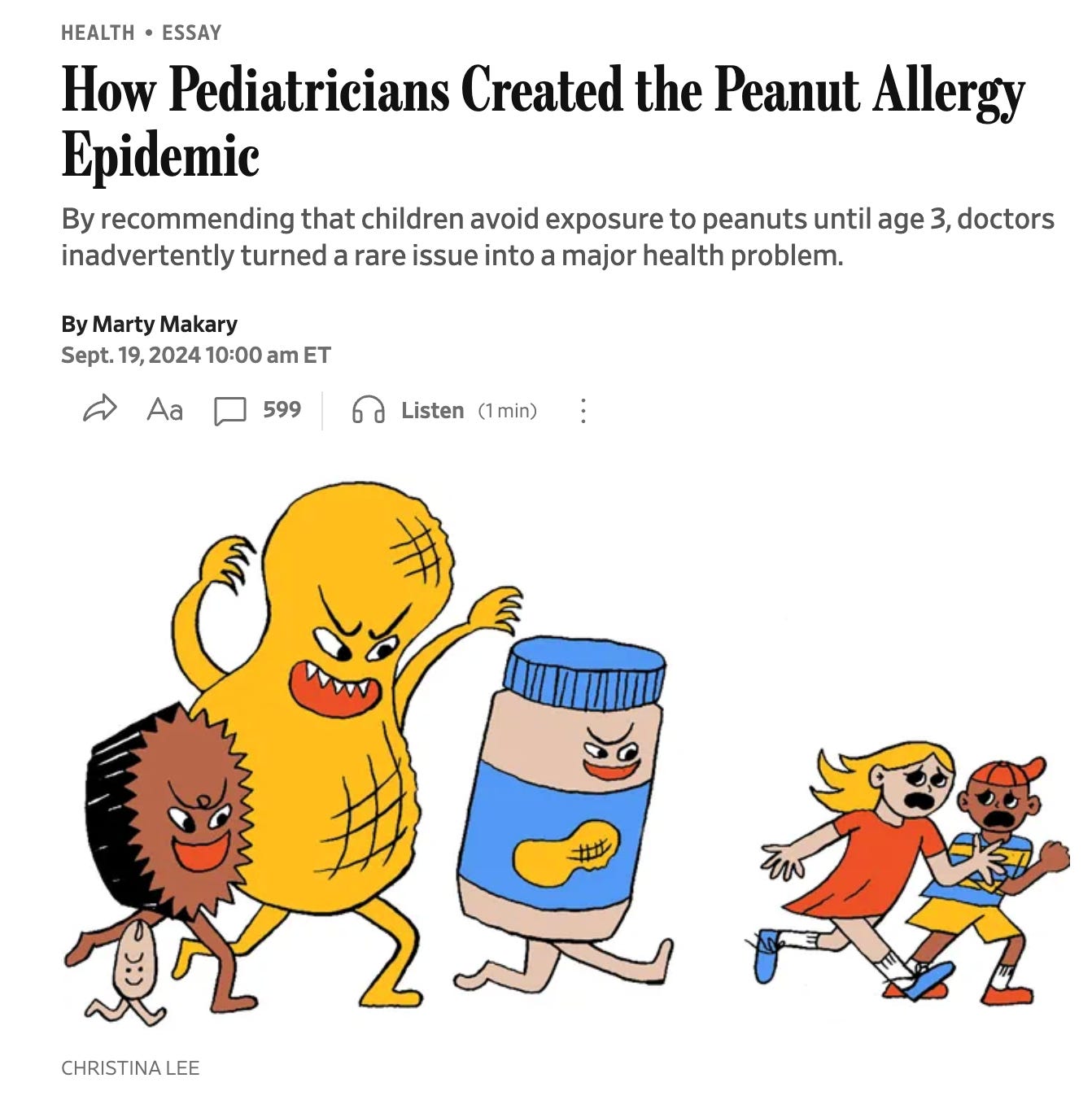
That title bites, and it’s 100% accurate.
Consider that in 1999 only six in a thousand American children had a peanut allergy, most of them mild. The American Academy of Pediatrics wanted to give parents an answer, so in 2000 it told them to withhold peanuts from high-risk infants until age three, and from pregnant and nursing mothers before that.2 The data it was based on was very weak. The problem, as the AAP’s own authors acknowledged in the same document, was that nobody could reliably say which infants were high risk. A family history of allergy or asthma qualified under the loosest reading, which meant almost anyone qualified. It led to an entire generation of pediatricians, me included, teaching parents the same mnemonic. Age one, start milk. Age two, start eggs. Age three, start peanuts.
The pediatric allergists knew this wasn’t true all along, yet they were not invited into the room where the recommendation was created. One of them was Dr. Gideon Lack, a world-renowned pediatric allergist and a TIME100 Health honoree, whose LEAP trial showed the opposite was true. He demonstrated very clearly that early exposure cut the risk of peanut allergy by 86%.3 It took years for the guidance from the AAP to change. But the damage from a decade of avoidance was already written into a generation of immune systems, and into a country that now leads the world in peanut allergy. Makary calls this absolutism. Dressing a guess up as certainty because “we don’t know” is bad for public trust. He is right to name it. What bothers me is that we talk about it like it happened once, in one specialty, a long time ago.

Prehospital medicine has its own peanuts, and we are living inside at least three of them right now.
Start with ventilation rate in pediatric cardiac arrest. For years EMS clinicians were taught roughly ten breaths a minute once an advanced airway was placed, a number extrapolated mostly from adult and animal physiology suggesting that faster ventilation raised intrathoracic pressure and choked off coronary perfusion pressure during compressions. In 2020 the American Heart Association moved that number to 20-30 breaths a minute, doubling or tripling it depending on where in the range a clinician lands.4 The evidence behind that jump was a single pediatric in-hospital study of roughly fifty children, observational rather than randomized, showing higher rates associated with better survival. But the data were collected from PICU patients, 60% of whom had pre-existing congenital heart disease, 77% who were on pressors at the time of their “arrest,” and 74% of whom still had a pulse.
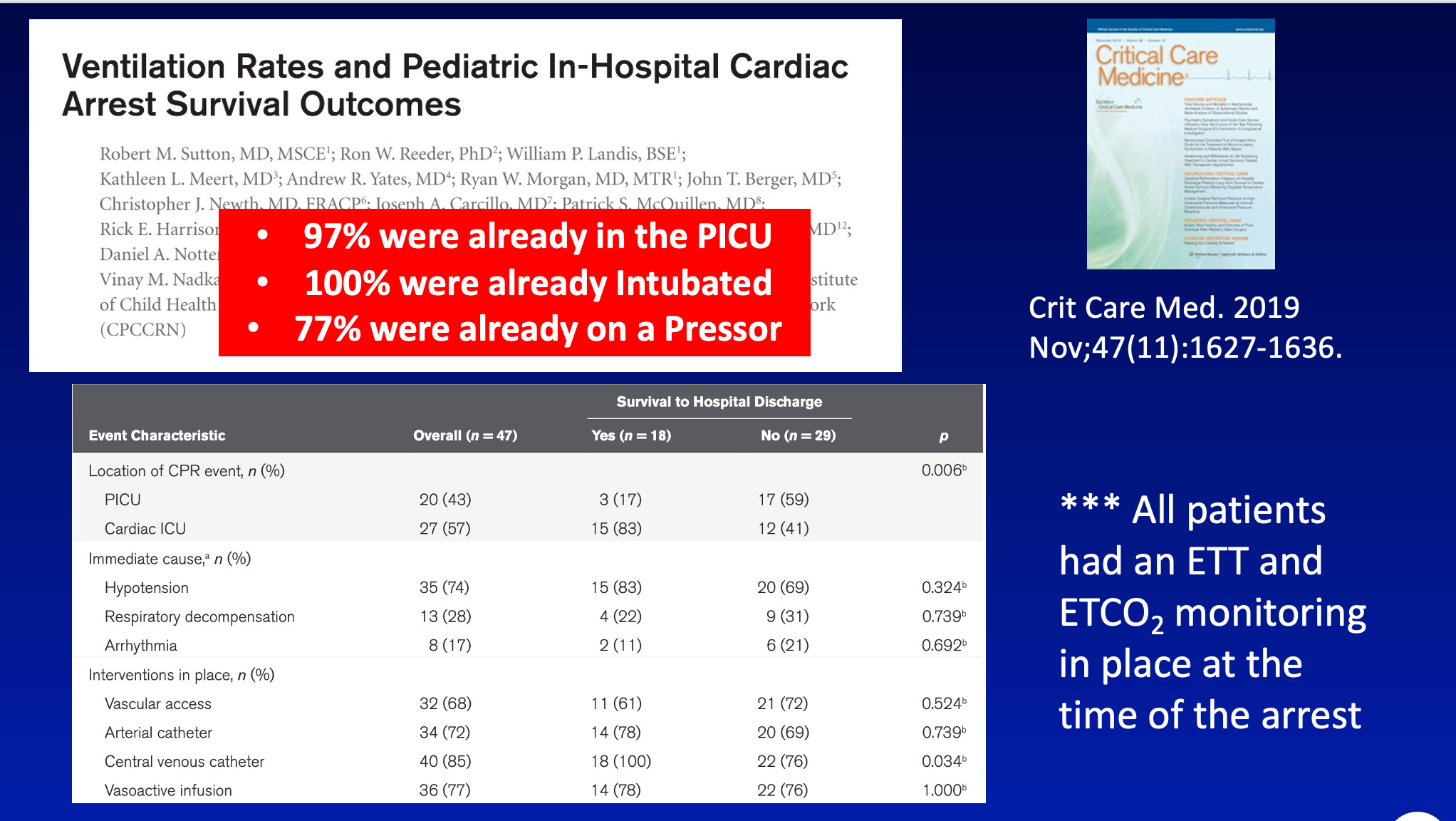
The AHA and the European Resuscitation Council both classify their own pediatric ventilation guidance as weak, built on very low-quality evidence, and both list optimal ventilation rate as a research gap requiring urgent study.5 The two councils do not even agree with each other. Europe still allows a range down to ten breaths a minute for older children. Meanwhile, a study published this year found that field crews are actually delivering an average of 7.5 breaths a minute during pediatric out-of-hospital arrest, well below either recommendation.6 We changed a national standard by as much as three hundred percent on the strength of one small observational study, two continents disagree on the number, and the clinicians doing the ventilating in the field have landed somewhere else entirely.
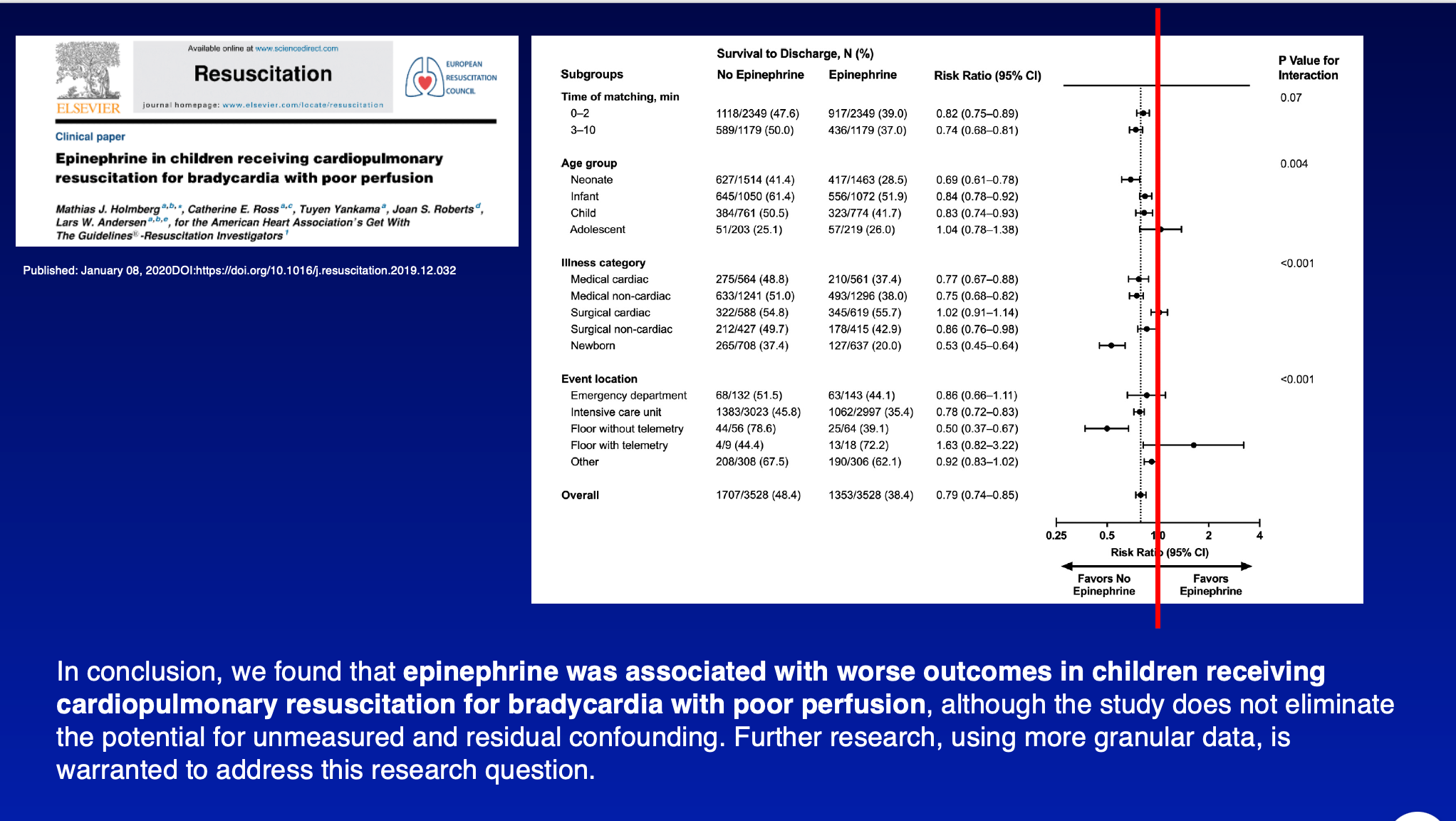
Then there is epinephrine dosing in symptomatic bradycardia. Current PALS guidance gives the identical dose, 0.01 mg/kg, to a child in cardiac arrest and to a child with a pulse who is bradycardic and poorly perfused. In 2020, Mathias Holmberg and colleagues used the American Heart Association’s own Get With The Guidelines-Resuscitation registry to look at what actually happens to these children, and the results were not reassuring. Children who received epinephrine for bradycardia with poor perfusion had lower survival to hospital discharge, lower rates of return of spontaneous circulation, lower 24-hour survival, and worse neurological outcomes at discharge than children who did not.7
Adult resuscitation abandoned this dosing logic years ago. When an adult has a pulse but a failing pressure, we no longer push a full code dose of epinephrine. We push a tenth of it, titrated, and call it “push dose.” The American Heart Association’s own 2018 scientific statement on children with cardiac disease said the same principle should apply to pediatrics, a starting dose of one microgram per kilogram, one tenth the arrest dose, for a myocardium that is failing but has not yet stopped.8 Eight years later, that guidance still has not made it into the mainstream PALS algorithm most clinicians are taught, despite a registry study showing the current dose is associated with worse outcomes. We give a full cardiac arrest dose of epinephrine to children who are, by definition, not in cardiac arrest, and we call it standard of care.
Then there is epinephrine in shockable rhythms, and this one might be the sharpest example of the three. For decades the reflex was the same no matter what the monitor showed. Push a milligram every three to five minutes. That logic holds for asystole and PEA, rhythms with no organized electrical activity, where vasoconstriction buys the heart time to respond to something. It never made the same sense in ventricular fibrillation, where the heart already has electrical activity and defibrillation is the definitive treatment. Push standard dose epinephrine into a fibrillating heart and you raise myocardial oxygen demand, promote recurrent VF after a successful shock, and impair the microvascular perfusion you are trying to restore.
The evidence has been building for years. PARAMEDIC2, the largest placebo controlled epinephrine trial ever run, found more patients got a pulse back but no improvement in survival with a good neurologic outcome, and whatever benefit existed converged to zero at about twenty minutes of pulselessness.9 A 2023 network meta-analysis in Chest found standard dose epinephrine improved survival to discharge for non-shockable rhythms but showed no benefit for shockable ones.10 A 2025 population based analysis of more than three thousand patients with refractory VF found a favorable neurologic outcome in half of the patients who did not receive epinephrine, compared with eleven percent of those who did.11 That is a fourfold difference, in the patients with the best chance of walking out of the hospital. Palm Beach Gardens Fire Rescue removed epinephrine from its shockable rhythm protocol on the strength of this data, and the early outcomes support the change, though the sample is still small. The AHA’s own guidelines have been moving the same direction since 2020, deferring epinephrine in shockable rhythms rather than pushing it on the same clock as everything else. We are not at a settled national algorithm yet. But unlike the peanut story, the profession is at least looking hard at the data while the old guess is still being defended, instead of waiting fifteen years to admit it.
Makary’s answer for the peanut era is not a new set of absolute rules pointed in the other direction. It is a culture willing to say we do not know yet, and systems that let evidence update practice in years, not decades. That is the work in front of every EMS medical director right now, in ventilation rates, in epinephrine’s dosing, in epinephrine’s role in shockable arrest, and in every protocol we have not questioned recently enough.
Dr. Makary is not writing about EMS. He does not need to. The peanut is never really about the peanut. It is about how easily an institution mistakes its own certainty for the truth, and how long it takes a system built on protocol to admit it was wrong. Ours is no exception.
If this bothers you as much as it bothers me, read the rest of the book. Peanuts are only chapter one. Makary spends the rest of Blind Spots walking through the same pattern again and again, in the hormone replacement therapy panic that scared a generation of women off treatment that helped them, in the low-fat low-cholesterol dogma we handed out for decades, in the years experts insisted opioids were not addictive, in a fourteen-year ban on silicone breast implants with no real evidence behind it. Chapter after chapter, the same story. An institution takes a position, defends it long past the point the evidence supports, and eventually gets around to saying the two words that would have spared everyone years of harm. “We don’t know yet.”
Buy the book. Read one chapter a night. Then go back and read your own protocols with the same skepticism.
References
1. Makary M. Blind Spots: When Medicine Gets It Wrong, and What It Means for Our Health. Bloomsbury Publishing; 2024.
2. American Academy of Pediatrics, Committee on Nutrition. Hypoallergenic infant formulas. Pediatrics. 2000;106(2 Pt 1):346-349.
3. Du Toit G, Roberts G, Sayre PH, et al. Randomized trial of peanut consumption in infants at risk for peanut allergy. N Engl J Med. 2015;372(9):803-813.
4. Topjian AA, et al. Part 6: Pediatric Basic Life Support: 2025 American Heart Association and American Academy of Pediatrics Guidelines for Cardiopulmonary Resuscitation and Emergency Cardiovascular Care. Circulation. 2025;152(suppl 2).
5. Optimal Ventilation for Cardiac Arrest, NIH-funded multicenter trial protocol (NCT07114510); AHA and European Resuscitation Council pediatric ventilation guidance, classified as weak recommendation, very low-quality evidence.
6. Ventilation Rates and Capnography in Pediatric Out-of-Hospital Cardiac Arrest with Advanced Airways. Prehosp Emerg Care. 2025 May 29 [online ahead of print]. doi:10.1080/10903127.2025.2496756.
7. Holmberg MJ, Ross CE, Yankama T, Roberts JS, Andersen LW. Epinephrine in children receiving cardiopulmonary resuscitation for bradycardia with poor perfusion. Resuscitation. 2020;149:200-207.
8. Marino BS, et al. Cardiopulmonary Resuscitation in Infants and Children With Cardiac Disease: A Scientific Statement From the American Heart Association. Circulation. 2018;137(22):e691-e782. [Verify exact citation before publication.]
9. Perkins GD, Ji C, Deakin CD, et al. A Randomized Trial of Epinephrine in Out-of-Hospital Cardiac Arrest. N Engl J Med. 2018;379(8):711-721.
10. Fernando SM, Mathew R, Sadeghirad B, et al. Epinephrine in Out-of-Hospital Cardiac Arrest: A Network Meta-analysis and Subgroup Analyses of Shockable and Nonshockable Rhythms. Chest. 2023;164(2):381-393.
11. Fanet L, Javaudin F, Dumas F, et al. Association of epinephrine and outcome in cardiac arrest with refractory shockable rhythm: a population-based, propensity-score matched analysis. Crit Care. 2025;29:252.
12. Makary M. How Pediatricians Created the Peanut Allergy Epidemic. Wall Street Journal. September 19, 2024.